

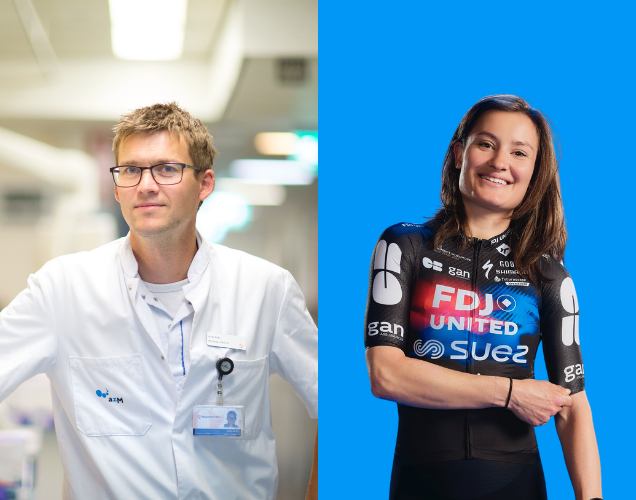
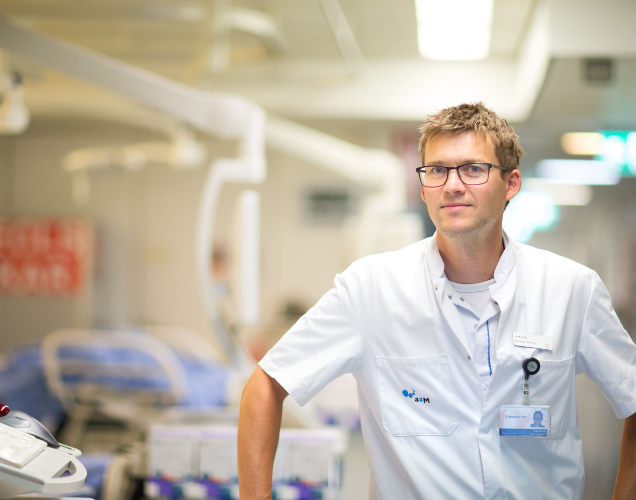
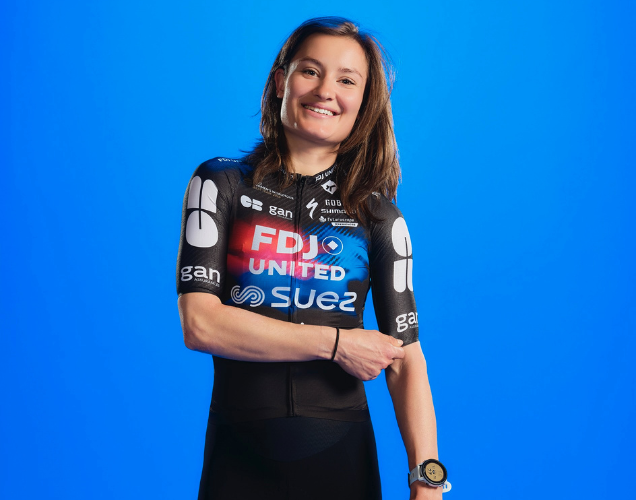
Marcel Aries is a neuro‑intensivist at MUMC+ and the founder of the Brain Battle Fund. Eva van Agt is a professional cyclist riding for the French WorldTour team FDJ-Suez. In this dual column, they bring their worlds together: elite sport and brain health. They reflect on what strikes them in their work and in their shared commitment to fighting brain injury.
How proud we are to have you as an ambassador for the Brain Battle Fund. I read about your crash and concussion in de Volkskrant some time ago, and my first thought was: this cyclist truly understands how vulnerable the brain is. Perhaps she might be willing to help put cycling safety on the agenda and show others how important it is to take care of their brains.
After a cup of coffee in Maastricht, I knew enough. You were open to it.
What stayed with me most? Your focus. As a professional athlete, so much of your life revolves around yourself and your sport. Understandably. But that’s exactly why it’s remarkable that you now also want to give something back to society. We’ll hold you to that 🙂
During our second conversation, this idea emerged: a dual column. A way to get to know each other better, and to connect our worlds.
I’m curious: have you ever considered working in healthcare? My own cycling career was short. Cycling club Schijndel. Until a crash over the foot of a crowd barrier. After that, the confidence was gone.
In intensive care, I see severe injuries every day. Yet I struggle to watch crashes in the peloton. The risks are so visible.
And still… on 19 April I rode with the doctors’ team in the 2026 Amstel Gold Race. You rode the Dutch classic that same day.
How do you view the risks in the peloton? And when, for you, is it “worth it”?
The first one is in the bag! I’m delighted to help raise awareness for this wonderful fund. Healthcare absolutely fascinates me, but the truth is I have far too many interests. In the end, I chose to study mathematics and data science. I’m not doing anything with it at the moment, though; I feel fortunate to earn my living through cycling. And I adore the French language, which I’m learning both in my free time and ‘at work’ 😉
Cycling is certainly not without risk. Even training on public roads can lead to some hair‑raising situations. Racing is a different level altogether. Crashing is part of the sport. Most of the time you come away relatively unscathed, but I’ve already had three concussions. Each time, you wonder how long recovery will take and whether you’ll fully recover at all. There are plenty of stories of riders who have had to stop because the headaches return as soon as they get back on the bike. I count myself lucky that I’ve always recovered relatively quickly and completely.
But I, too, sometimes imagine the scenario of a crash with serious injury, the kind you see every day in intensive care. I’ve had moments in races where the fear was so overwhelming that I thought: “That’s it, I’ll finish this race and then hand in my contract.” Fortunately, most of the time I can enjoy the adrenaline that comes with taking risks. You have to, otherwise you won’t last. For me, the risks remain worth it as long as I don’t feel like I’m just ‘peloton filler’. I want to be able to influence the race in some way every time I line up. Not necessarily as a contender for the win, but as a domestique who can make a meaningful contribution to my leaders’ performance. And hopefully, that leads to victory!
Each year, around 130,000 people in the Netherlands sustain a brain injury. In the intensive care unit of MUMC+, patients are treated every day who are fighting for their lives. Despite all efforts and modern medical care, more than 60% leave hospital with a permanent, severe disability. And yet, in over 25 years, hardly any progress has been made in the treatment of severe traumatic brain injury. This must change.
The Brain Battle Fund is committed to improving the treatment of brain injury. With external support, the fund finances groundbreaking research at Maastricht University and MUMC+ aimed at optimising cerebral blood flow so that more brain cells can recover in intensive care. The more cells that heal, the smaller the chance of long‑term disability, a profound improvement in quality of life. In addition, the fund runs numerous awareness campaigns focused on cycling safety.