

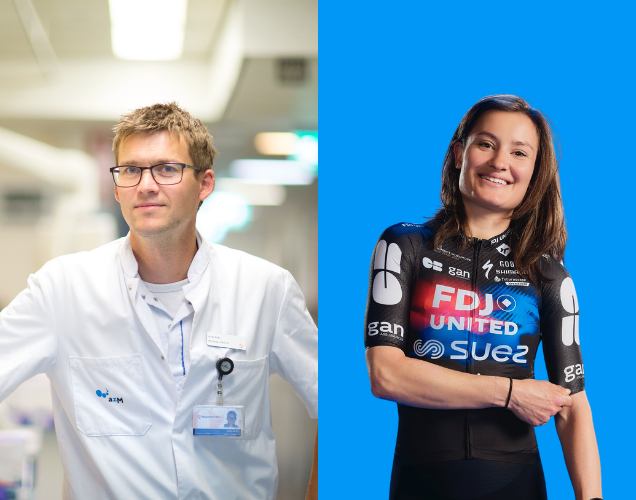
Marcel Aries is a neuro‑intensivist at MUMC+ and the founder of the Brain Battle Fund. Eva van Agt is a professional cyclist riding for the French WorldTour team FDJ-Suez. In this dual column, they bring their worlds together: elite sport and brain health. They reflect on what strikes them in their work and in their shared commitment to fighting brain injury.
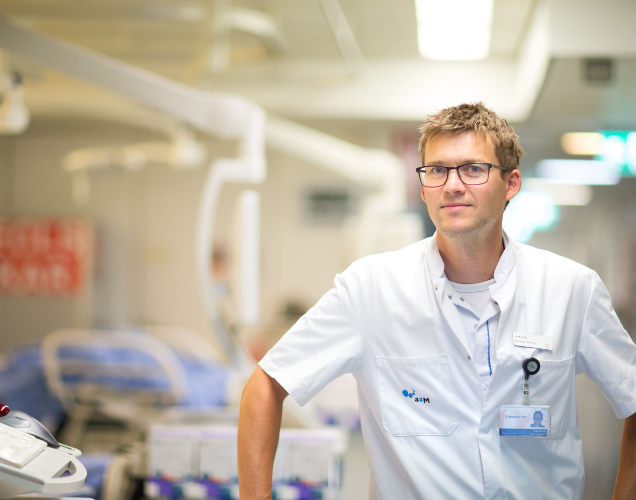
First of all, congratulations on your magnificent victory in the Giro. What a race, what a spectacle. From day one, the Dutch riders were making headlines around the world (Lorena Wiebes’ bicycle certainly helped with that). You have quite literally written a piece of cycling history.
You have now completed two Grand Tours in succession. Your body must surely be feeling the effects. Last week, I attended a film evening celebrating ten years of Limburg Cycling. They screened the documentary Tour de France: New Heroes, featuring a very young Tom Dumoulin in a leading role. It offered a fascinating glimpse into the life of a professional cyclist. At the time, the Dutch team achieved four stage victories with Marcel Kittel and a perfectly functioning sprint train.
What stayed with me most, however, were not the victories themselves but the stories behind them. Naturally, the legs grow tired, but the psychological aspect was at least as intriguing. The endless travelling, a different hotel room every day, the mountains, the pressure, the constant need to eat, recover and perform. From the outside, the life of an elite athlete often appears romantic; up close, it is revealed to be a relentless sequence of discipline and sacrifice.
While the documentary showed what elite sport does to a body, last weekend I witnessed what time does to one. My weekend shift was a particularly demanding one. Why? The average age of the seriously ill patients admitted to our department was around ninety years old. Yes, you read that correctly: ninety. People who have lived through wars, economic crises and a lifetime of experiences, yet who still take part in everyday traffic.
A lorry versus a walking frame. An attempt to just make it across the road in time. A narrow escape. Later, the walking frame stood beside the hospital bed as silent evidence, bearing only a couple of scratches. As though the metal had been luckier than its owner.
Later, a colleague sent me a video from a cycling race. Out of nowhere, an elderly woman on a mobility scooter crossed the road from the crowd. Half a second later, a large portion of the peloton was sprawled across the tarmac. I suspect it is probably better that you do not see that footage.
Nevertheless, I cannot shake a particular thought. In many of the accidents I encountered over the weekend, speed, limited awareness and perhaps impaired vision or hearing appeared to play a significant role. Traffic has become faster, but the reaction times of some road users have not evolved at the same pace.
What affected me most, perhaps, is the reality that many of these elderly patients will never fully recover. For some, that accident may well have been the final major event of their lives.
It is a poignant contrast: while you spend each day in the Giro pushing your limits to gain a few precious seconds, others in old age find themselves losing the battle against time and speed. One is constantly striving to move faster; the other is simply trying to reach the other side of the road safely.
How does that feel from your perspective? After weeks of racing at the absolute limit, through descents, crosswinds and mass sprints, I imagine you experience speed very differently from most people. Do you find that your perception of risk changes? Or does it remain remarkable to realise just how vulnerable a human being truly is, whether you are ninety years old with a walking frame or thirty years old with a race number pinned to your back?
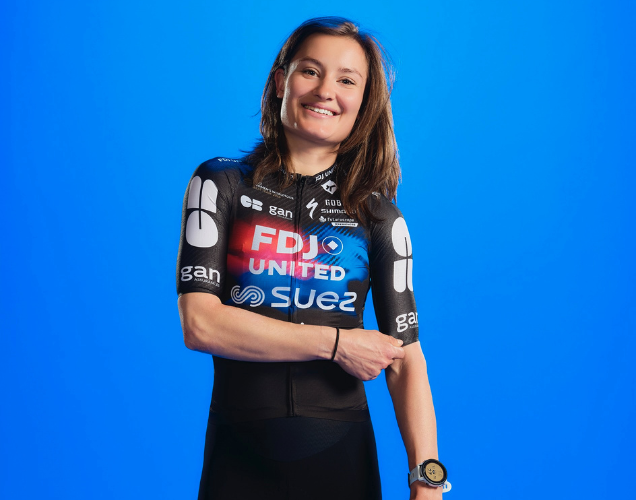
Thank you for the congratulations! It really was a dramatic finale, for us as well. For a long time, it seemed like an impossible task, which made it all the more special when everything finally fell into place. It was a privilege to be a part of it.
I do think I experience speed differently from most people. If there are no particularly technical corners on a descent, 70 km/h can feel remarkably relaxed. It is a bit like driving on the motorway for a long period and then suddenly entering a built-up area. Thirty kilometres per hour can feel as though you are standing still, and if you are not paying attention it is surprisingly easy to exceed the speed limit.
That said, I do not think it is really about speed itself, but rather about the complexity of traffic situations. The ability to process those situations and react appropriately is challenged constantly during a race. In the first few training rides after a race, I notice that I carry more speed through corners, scan junctions more quickly, and weave more efficiently around pedestrians and cyclists in Maastricht city centre. On the rare occasion that I drive home by car after a race, my brain still seems convinced that I need to squeeze through every gap and take every bend at twice the necessary speed. Under normal circumstances, I am actually a very cautious driver. So much so that my mother recently wanted to catch a train and, slightly irritated, said: “Don’t drive like an old pensioner.”
I also tend to ride defensively on the bike. It is an illusion to think that all risks can be avoided, but I do try to anticipate potentially dangerous situations. Children on a cycle path, side roads with poor visibility, elderly people on e-bikes whom I would like to overtake but whose body language already suggests that they are about to turn right across my path.
Sometimes I become frustrated by the aggressive behaviour of other cyclists. Not long ago, an older cyclist was sitting in my slipstream. Just before a crossing partially obscured by vegetation, I eased off, while he shot past me at full speed and crossed the junction completely blind. When I caught up with him again, he informed me that cyclists have priority these days. I replied that I was aware of that, but that I was not quite ready to find myself sprawled across the bonnet of a car.
It remains difficult: sharing the road sensibly when different road users have very different perceptions of speed. I still struggle, for example, with the dilemma of whether or not to ring my bell. Often there is more than enough room to pass people on a cycle path, and you are past them before they even realise you were there. Yet they are startled nonetheless and you get an angry “Ring your bell!” shouted after you.
If you do ring the bell, people are sometimes so startled by the sudden sound that it provokes an equally irritated response. Or worse, they glance over their left shoulder and inadvertently steer their entire bicycle across the cycle path.
In short, I try to minimise risk during training by riding defensively and remaining tolerant towards other road users. I was sorry to read about all the elderly people ending up in your ICU following traffic accidents. Perhaps our roads need to be designed differently, but as a starting point we can all pay a little more attention to this vulnerable group and be mindful of unexpected actions.
Each year, around 130,000 people in the Netherlands sustain a brain injury. In the intensive care unit of MUMC+, patients are treated every day who are fighting for their lives. Despite all efforts and modern medical care, more than 60% leave hospital with a permanent, severe disability. And yet, in over 25 years, hardly any progress has been made in the treatment of severe traumatic brain injury. This must change.
The Brain Battle Fund is committed to improving the treatment of brain injury. With external support, the fund finances groundbreaking research at Maastricht University and MUMC+ aimed at optimising cerebral blood flow so that more brain cells can recover in intensive care. The more cells that heal, the smaller the chance of long‑term disability, a profound improvement in quality of life. In addition, the fund runs numerous awareness campaigns focused on cycling safety.