

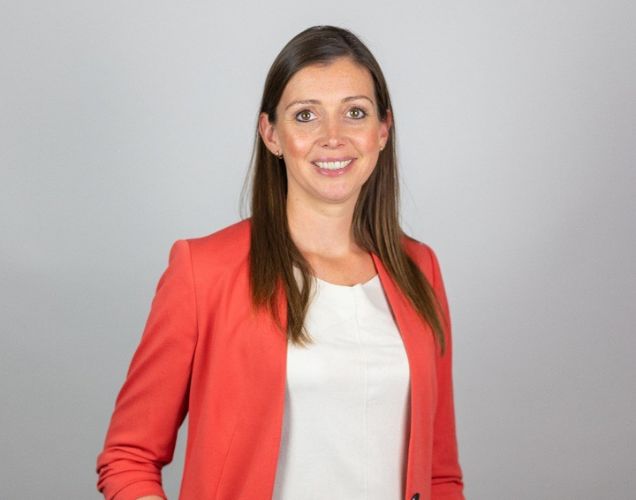
Resilient organisations are not those that avoid change, but those that are prepared for it. That is the conviction of Daisy Blaauw. As an organisational development consultant at ORGfit, a board member of the University Fund Limburg, and a supervisory board member at Maastricht Marketing, she helps organisations navigate complexity and uncertainty. Her key to success? Connection: bringing together different perspectives and actively involving people in the process. It is an approach rooted in her time at University College Maastricht (UCM) and one that has become the common thread throughout her career.
Where others shy away from complex challenges, Daisy sees opportunity. Whenever different interests and perspectives come together, she finds the space to do what she does best: bringing people together, creating momentum and helping organisations make future-focused decisions. “If I can help a board make clear choices and then see a team move forward with confidence, that gives me enormous energy.”
That momentum, however, does not happen by itself. For Daisy, sustainable change begins with creating understanding and engagement. “People need to feel heard,” she explains. “Developing a strategy and putting it on paper is important, but real progress only happens when people support it and put it into practice.” This requires organisations to create space for different perspectives and actively involve people in decision-making. Only then can they build the commitment needed to make change happen.

This conviction did not emerge overnight. Daisy’s perspective on organisations and change was shaped during her studies at University College Maastricht (UCM). Growing up in South Limburg, it was there that she first found herself in an international and multidisciplinary environment. “The first thing I learned was to look at a challenge from different perspectives and cultural backgrounds.”
That open-minded outlook was strengthened by Maastricht University’s Problem-Based Learning (PBL) approach. “As a student at Maastricht University, problem-based learning teaches you to embrace the unfamiliar,” Daisy says. “Persevering, questioning assumptions, asking critical questions and really getting to the heart of an issue – those are the things I learned during my time at UM.” It is precisely this way of thinking that gave her the confidence to embrace complexity rather than avoid it. Today, it lies at the heart of her work as an organisational development consultant.
Working daily on complex transformation programmes has given Daisy a clear view of what organisations need in order to remain future-proof. For her, resilience is not about preventing change, but about being equipped to deal with it. “Resilience means staying true to your direction and knowing where your organisation is heading. It means building an organisation that is robust enough to manage day-to-day operations while also being able to respond to change. At the same time, it requires enough flexibility to deal with the risks that changing circumstances inevitably bring.”
According to Daisy, resilience starts with clear choices, strong leadership and effective communication. Yet she believes this is where many organisations struggle. Too much attention is often paid to the content of a change programme, while its success ultimately depends on the people responsible for delivering it. “Don’t do it alone – bring your organisation with you,” she emphasises. “I don’t believe in change that is driven purely from the top down. You need to involve a representative cross-section of the organisation, because those are the people who ultimately have to make it work together.”
For Daisy, this means not only managing change itself, but also strengthening an organisation’s capacity for change. “You need to be very aware of what your organisation requires when change is on the horizon or when risks emerge. You have to be prepared.”
Daisy brings that same philosophy to her role as a board member of the University Fund Limburg. Here too, she sees collaboration and connection as essential to tackling complex societal challenges. “The University Fund is an important bridge between the university and society. It supports projects that are not only valuable to science, but that also make a real difference to society.” It is precisely this connecting role that appeals to her. “It fits with who I am and what I believe in: moving forward together.”
And, as with organisations, moving forward together is not something that can be done alone. “Many of the challenges we face today are incredibly complex. They cannot be solved by a single organisation. When tackling these issues, you can benefit enormously from the knowledge, expertise and innovation generated by Maastricht University. I truly believe that partnerships achieve more.”
Students and researchers at Maastricht University also benefit directly from the Fund’s support. Students can apply for grants to organise activities and develop projects, while researchers receive financial support to explore promising new ideas. “You build a particular kind of resilience by enabling early-career researchers to respond to new developments and societal challenges with support from the Fund. I think that is incredibly valuable.” The impact extends beyond the university itself. “In doing so, we also strengthen the region’s capacity for innovation.”
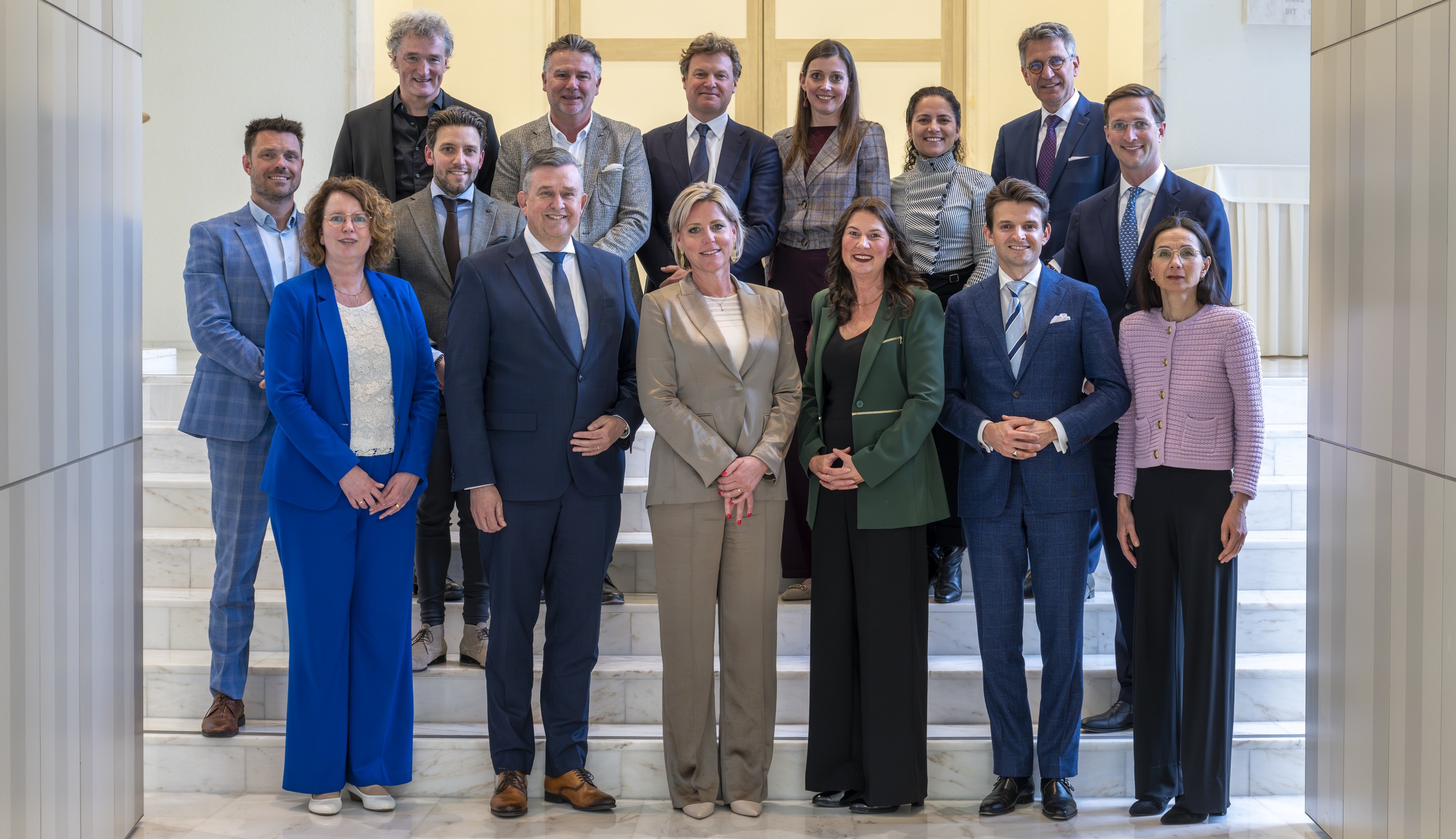
The board of the University Fund Limburg
Remaining resilient through innovation and new ideas is not only relevant for organisations and regions, but for individuals too. That is why Daisy believes continuous learning is so important. “When you keep learning, you continue building knowledge and adding new tools to your toolkit. But it also gives you the confidence to realise that new doesn’t have to be frightening.”
She completed programmes in coaching, leadership and education through Maastricht University’s Academy for Lifelong Development. Her goal was to deepen her understanding of how to guide people through change, deal with resistance and support educational innovation. She applies those insights every day. “You shouldn’t immediately offer solutions. Instead, you should engage people in conversation and help them develop their own insights. That enables people to build on their own strengths.”
According to Daisy, the value of lifelong learning extends beyond the individual. “A learning culture strengthens an organisation’s resilience.” It also increases motivation and engagement. “People are much more motivated and committed when they have opportunities to develop themselves and contribute.”
For Daisy, resilience is ultimately not about preventing change, but about having the capacity to navigate it. By connecting different perspectives, bringing people together and maintaining a future-focused outlook. That, she believes, is also the strength of Maastricht University, the University Fund Limburg and the UM Academy for Lifelong Development: bringing together people, ideas and knowledge to create meaningful progress for society.
As Daisy’s story illustrates, learning does not stop after graduation. Her programmes form part of the broad Lifelong Development offering at Maastricht University, brought together under the UM Academy.
Here, education for professionals is clearly organised in one place: from short courses to in-depth programmes, all focused on immediate practical application and current developments in the field. In this way, UM remains an engaged partner in your professional growth long after your student years.