

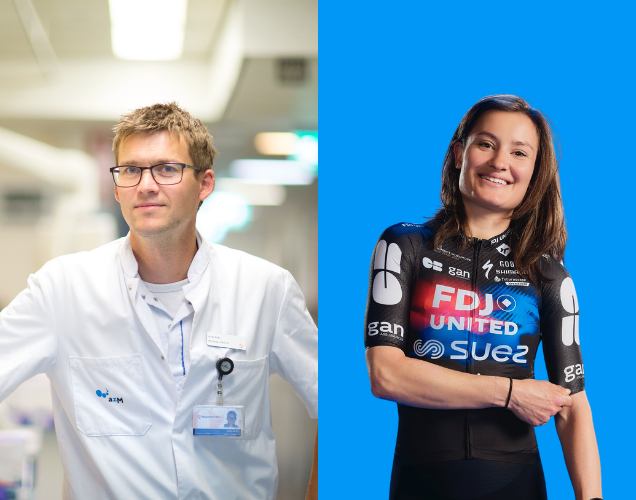
Marcel Aries is a neuro‑intensivist at MUMC+ and the founder of the Brain Battle Fund. Eva van Agt is a professional cyclist riding for the French WorldTour team FDJ-Suez. In this dual column, they bring their worlds together: elite sport and brain health. They reflect on what strikes them in their work and in their shared commitment to fighting brain injury.
As you wrote in your previous column, you witness severe injuries and very ill people on a daily basis. You work in situations where ‘life’ is suddenly and acutely at stake. The medical decisions you have to make can mean the difference between life and death. How do you cope with that level of responsibility? Does it cause a great deal of stress? I can imagine there are nights when you don’t sleep well. And do you carry this with you when you go home, or are you able to switch off? If so, how?
When we had coffee together a little while ago, you told me how full your schedule was that day. I was genuinely impressed; you had already been seeing patients from half past six in the morning to make sure you had enough time for all your appointments. The night had been short. Yet your work requires you to be constantly switched on and fully alert. How do you manage that?
I have enormous respect for the responsibility you carry and the number of hours you put in. The fact that you still find the time and energy to dedicate yourself to such an important cause is truly admirable. I’m very curious to read how you manage to make it all work.
It’s good that you’re concerned about doctors’ stress levels and sleep 😊 That’s exactly why we recently went on strike for two days to demand better working conditions. It felt a bit uncomfortable — after all, we have a wonderful profession and we’re well paid — but ultimately, no patient wants a doctor at their bedside who is overtired or overwhelmed. Better working conditions benefit both doctors and patients in the end.
I do find my work in intensive care quite demanding. We work every day with patients whose lives are acutely at risk, and sometimes decisions have to be made very quickly. At the same time, it helps enormously that in an academic hospital you’re never doing this alone. We have frequent moments to discuss cases, and we can always consult colleagues, specialists and nurses. That shared responsibility makes a real difference.
Of course, I feel extra tension when patients with severe brain injuries are admitted — and unfortunately, there are many of them. In those moments, I don’t want to miss anything; I want to weigh every option carefully and do everything possible to support recovery. But the brain and nervous system are not always forgiving. Sometimes preventing further damage is already a significant achievement.
You also asked how I stay sharp on busy days. I don’t always manage perfectly. Routine helps, as does teamwork, coffee 😉 and trying to prioritise well. And to be honest: sometimes you’re just tired. What helps me switch off? Cycling home. On the way I encounter one overpass and two tiny hills — just enough to clear my head. By the way, I saw you attempted a King of the Mountain (KOM) on the Camerig! I haven’t seen the result yet, but should team leader Demi already be worried about next year’s Amstel Gold?
Meanwhile, the Brain Battle Fund is running at full speed. The sponsored ride during the Amstel Gold Race and our coffee stand along the route raised a fantastic amount. It was wonderful to see a whole group of cyclists passing by in Brain Battle jerseys. And perhaps even more importantly: thanks to a new editor, we’re now active on Instagram — we’re keeping up with the times too.
Best of luck in the Giro d’Italia from 30 May onwards!!
Each year, around 130,000 people in the Netherlands sustain a brain injury. In the intensive care unit of MUMC+, patients are treated every day who are fighting for their lives. Despite all efforts and modern medical care, more than 60% leave hospital with a permanent, severe disability. And yet, in over 25 years, hardly any progress has been made in the treatment of severe traumatic brain injury. This must change.
The Brain Battle Fund is committed to improving the treatment of brain injury. With external support, the fund finances groundbreaking research at Maastricht University and MUMC+ aimed at optimising cerebral blood flow so that more brain cells can recover in intensive care. The more cells that heal, the smaller the chance of long‑term disability, a profound improvement in quality of life. In addition, the fund runs numerous awareness campaigns focused on cycling safety.