

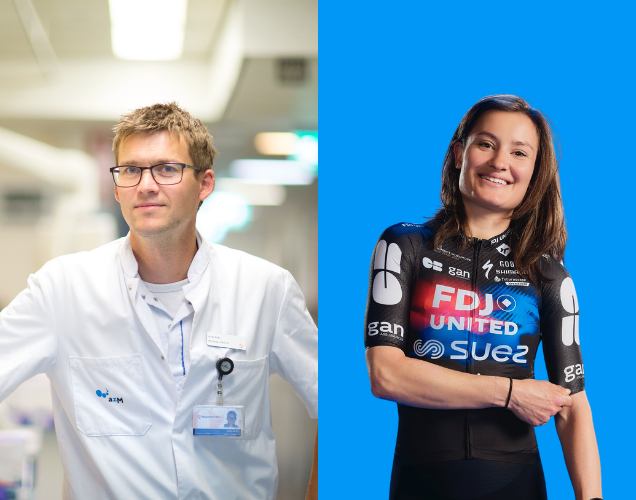
Marcel Aries is a neuro-intensivist at MUMC+ and the founder of the Brain Battle Fund. Eva van Agt is a professional cyclist riding for the French WorldTour team FDJ-Suez. In this dual column, they bring their worlds together: elite sport and brain health. They reflect on what strikes them in their work and in their shared commitment to fighting brain injury.
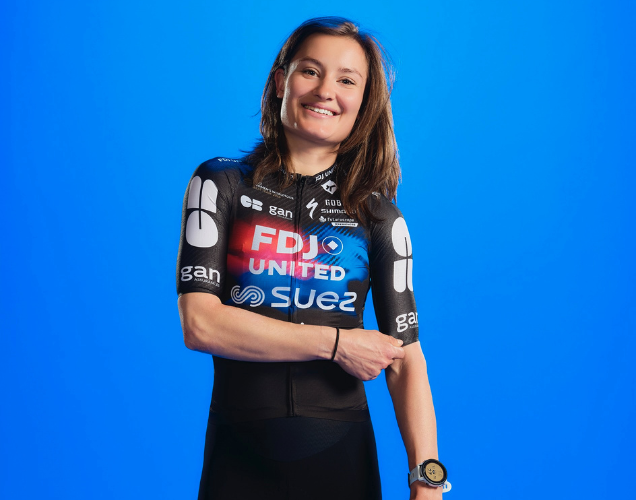
Here I am again, after a short summer break. A little while ago, I came across an interesting news report: in Houten, they are currently experimenting with a speed limit for cyclists. On one particular cycle path, you are now only allowed to ride at a maximum of 20 kilometres per hour. There are also plans for a trial in Amsterdam. As a road cyclist, my hackles immediately rose when I read these reports. Twenty kilometres per hour!? If this were to become a nationwide rule, how am I supposed to train? And what about when I’m racing to the station on my bike to catch the train? With a bit of a tailwind, you can easily go faster than that. Not to mention the descents in the Limburg hills… Fortunately, I soon read that cyclists are allowed to move onto the road instead.
There are also calls within professional cycling to limit speeds during races. Thanks to huge advances in aerodynamics, we are getting faster and faster. In sprints, male riders now regularly reach speeds of 70 to 80 kilometres per hour. Last year, the UCI (the international governing body for cycling) wanted to trial a maximum gear ratio, something that has actually been in place for youth riders for many years. In the end, however, the plan was blocked by SRAM (a company that manufactures bicycle components), for whom the financial consequences would have been considerably greater than for its competitors.
In my opinion, introducing a maximum gear ratio should not be the priority. Issues such as poor road surfaces, obstacles on the course and dangerous riding by cyclists or motorbike riders are more often responsible for serious crashes. And whether you can keep pedalling at 70 or 80 kilometres per hour… The injuries sustained in a crash at those speeds are unlikely to differ much. What’s more, most of these high speeds are not achieved by pedalling anyway, but by making use of the slipstream. A peloton can generate enormous speeds as riders build up momentum in the wheels and then fly past in an aerodynamic position – a kind of washing-machine effect.
As far as I’m concerned, introducing a maximum gear ratio to limit speeds in races is therefore not the right step at this point. What do you think about the possibility of introducing speed limits on cycle paths?
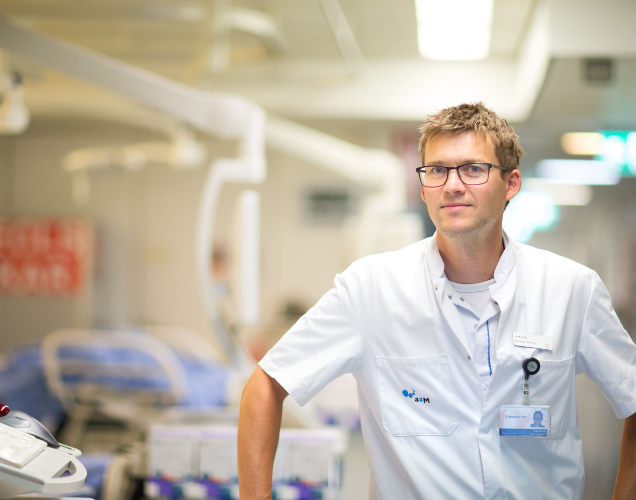
The holidays are over here too. In Spain, the heat meant that our bike rides were taken at a somewhat more leisurely pace. Something I didn’t really see reflected in the Tour de France, either the men’s or women’s race!
First of all: congratulations on your first victory. It had obviously been coming for a while.
I also read the article about the speed limit on the cycle path in Houten. As far as I understand, it is still an experiment, but I think it is a good thing that different approaches are being explored to see how we can reduce the number of cycling accidents and their severity.
I don’t know the cycle path in question, but I can well imagine that at peak times a kind of perfect storm develops: everyone is heading to work, school or childcare at the same time, and everyone is in a hurry. What particularly strikes me is the huge variation in speed. The slow schoolchild is overtaken by the average cyclist (read: me), who is then overtaken by a grandmother on an e-bike, who in turn is overtaken by the commuter on a speed pedelec. And all the while, we’re all busy with anything and everything except the traffic around us. We also seem to use our bicycle bells surprisingly little.
So I can understand the idea of slowing down that ‘slipstream’ on cycle paths a little. When there is a large difference in speed, after all, a small, unexpected movement can have major consequences. At the same time, I do wonder how such a limit would be enforced in practice. How do you monitor a speed of twenty kilometres per hour? And how does the average cyclist actually know how fast they are going? Or will the problem simply shift to the road?
Maastricht also has a traffic concept that sounds great in theory. On the Groene Loper, faster cyclists are given space and cars are guests. Only those ‘guests’ don’t always behave like guests. More than a few motorists still try to overtake me, even though there simply isn’t enough room to do so safely.
During the Amstel Gold Race, I also regularly found myself thinking, while driving through the narrow sunken roads of Limburg in a convertible as a doctor: “Couldn’t we all just slow down a little…?” Perhaps that really is the simplest solution in the end. Less rushing from A to B. Although I suspect that, as a cyclist yourself – and especially after your first victory – you won’t be entirely convinced of that just yet!
Each year, around 130,000 people in the Netherlands sustain a brain injury. In the intensive care unit of MUMC+, patients are treated every day who are fighting for their lives. Despite all efforts and modern medical care, more than 60% leave hospital with a permanent, severe disability. And yet, in over 25 years, hardly any progress has been made in the treatment of severe traumatic brain injury. This must change.
The Brain Battle Fund is committed to improving the treatment of brain injury. With external support, the fund finances groundbreaking research at Maastricht University and MUMC+ aimed at optimising cerebral blood flow so that more brain cells can recover in intensive care. The more cells that heal, the smaller the chance of long‑term disability, a profound improvement in quality of life. In addition, the fund runs numerous awareness campaigns focused on cycling safety.