


UM alumna Fancy van de Vorst, who graduated in 1995 from the Faculty of Law, looks back on her time at Maastricht University (UM) with a broad smile and many fond memories. On the occasion of UM’s 50th anniversary, we spoke with her about her student years and the many ways in which she and the university have strengthened one another over time.
Fancy began her law studies in 1989. Her choice for Maastricht was a deliberate one: problem-based learning (PBL) immediately appealed to her. While other universities offered large-scale lectures, Fancy found in Maastricht a form of education that stimulated her curiosity and independence. “I didn’t just want to listen; I wanted to engage actively with the material. Thanks to PBL, I learned to approach issues from different perspectives.”
That skill still forms the core of her work today. Fancy is now Manager New Business at Stichting Next Nature, a board member of WTC Eindhoven Brainport and the University Fund Limburg, and an adviser to the Guided Coalition of the Province of Brabant. In all these roles, she recognises how the PBL mindset—characterised by collaboration, connecting perspectives, and critical analysis—supports her on a daily basis. “I even notice that this way of working is becoming second nature to others around me as well.”
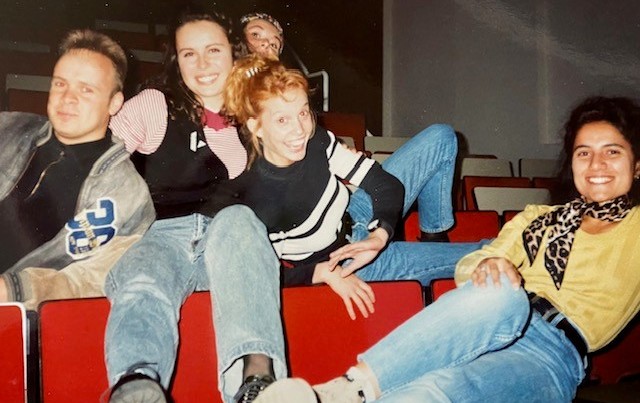
Fancy with a few fellow students in a lecture hall of the Faculty of Law
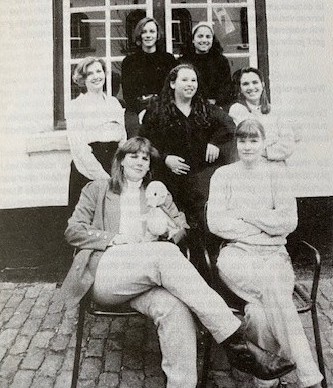
Fancy as Chair of the Law Faculty Association Rechtstreeks
The reciprocal relationship between Fancy and UM began during her studies. She was active as a student ambassador, travelling across the country to provide information about the law programme and UM as an educational institution more broadly. She also served as chair of the study association Rechtstreeks.
After graduating, she continued to contribute to the UM community as a member of the editorial board of UMagazine on behalf of alumni, as founder of the alumni circle in Brabant, and as a board member of the University Fund Limburg. For Fancy, this ongoing engagement is only natural: “UM has always invested in its alumni. That sense of reciprocity is exactly why I have remained connected.”
A fine example of this is the UM Star Lectures, which Fancy initiated. Professors travel to alumni circles in various cities to give lectures. The format—a combination of academic content, networking, and lifelong development—proved successful: alumni brought colleagues along, and UM’s knowledge thus found its way into new, external networks.
Fancy has experienced first-hand how powerful the UM network can be. During her work for the municipality of Eindhoven, she prepared the substantive programme for a trade mission to Shanghai. Through the Shanghai alumni circle, she gained access to valuable contacts and even succeeded in arranging an interview for the Mayor and the King’s Commissioner. “Other provinces worked through the embassy, but alumni turned out to have a very different, complementary network. Simply having studied at the same university creates a bond.”
At Techleap, where she supported innovative scale-ups, she was also able—through UM alumni—to invite a medtech start-up to an event attended by the then Prime Minister, Mark Rutte. The UM network proved far broader than her own legal background and opened doors from Maastricht to Shanghai.
A common thread throughout Fancy’s career is social relevance and innovation. That is precisely why she readily said ‘yes’ when asked to join the General Board of the University Fund Limburg (UFL). She particularly values the Fund’s support for early-stage research that does not yet have access to major grants. “That very first step, often the most difficult one, is exactly what the Fund can make possible. In this way, we truly make a difference for early-career researchers who are not yet part of established research groups.”
According to her, the 60th anniversary of the Fund and the 50th anniversary of UM are moments to reflect on the impact achieved so far. “In recent years, the Fund has taken significant steps in strengthening its distinctive profile. A clear focus has been chosen on health and equal opportunities. That is where the strength of UFL lies.”
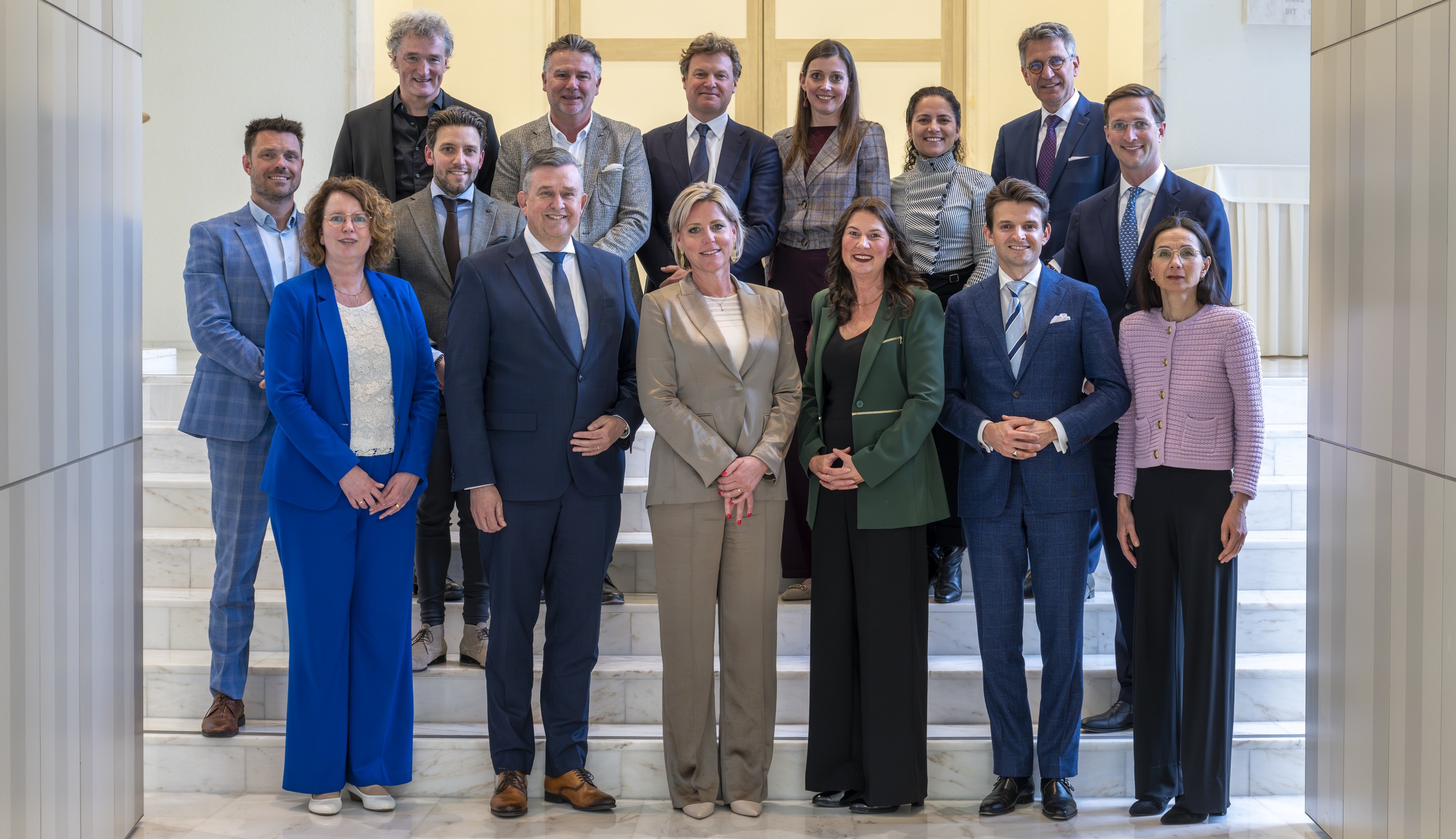
The board of the University Fund Limburg
Fancy also continues to engage with UM in her own professional development. Through UMIO, she completed the Programme for Upcoming Board Members, and she is now registered as a supervisor at UM. During the programme, she learned about legal frameworks, responsibilities, and the role of AI in supervision. “The programme is immediately applicable. Thanks to the practical examples, you stay close to the reality of the work. It has genuinely helped me to remain engaged with current developments, which is essential in a governance role.”
She brings this newly acquired knowledge into her board role at the University Fund Limburg. In this way, UM continues to inspire her—and in turn, she gives back to the university.
As Fancy’s story illustrates, learning does not stop after graduation. Her programme via UMIO forms part of the broad Lifelong Development offering at Maastricht University, brought together under the UM Academy.
Here, education for professionals is clearly organised in one place: from short courses to in-depth programmes, all focused on immediate practical application and current developments in the field. In this way, UM remains an engaged partner in your professional growth long after your student years.
The University Fund Limburg supports research and education at Maastricht University. It does so, among other things, by supporting researchers and students who are not yet eligible for large, regular grants. It is precisely at this early stage that the Fund makes a difference: by creating space for innovative ideas and emerging researchers.
Thanks to contributions from UM alumni, partners and donors, the University Fund Limburg remains an important link between academic ambition and societal impact.